Thursday, February 21, 2008

Potential vs. Experience

Potential versus experience, is always an interesting dynamic when awarding anyone any kind of pivotal position. In sports, you often see teams take a chance on a young rookie at the expense of a veteran player, hoping the potential of the rookie is better than the talent of the veteran. In the 2008 election 46 year old Senator Barack Obama represents that rookie potential, while Hilary Clinton represents the veteran experience for the Democratic nomination. Even if you know nothing about politics, you still likely know who Hillary Clinton is, and that she is the wife of former president Bill Clinton. However, chances are if you’re not into politics you had no clue who Barack Obama was until recently. The big name that Hillary carries seemed to be enough for victory early in the race for the Democratic nomination, however Obama has stormed ahead riding a wave of momentum. It is unclear who will come out on top, just as it was in 1860 when another young Illinois Senator was running for a nomination.
There is no doubt that this years election is unlike any other in many regards, the same can be said for the election of 1860, which to this day may have been the most important in our history. Like Obama, Abraham Lincoln was a young politician of Illinois running for his party nomination against a much more well known opponent. Interestingly enough he, like Obama, was running against a New York politician in William H. Seward. Seward, according to Paul F. Boller Jr, had, “long been prominent in national affairs, and was far better known than Lincoln, but he had made many political enemies.” (Presidential Campaigns 102) The enemies of Seward, and the lack of enemies against Lincoln would eventually lead him to victory on the third ballot, which represents the closeness in the nomination. The issues of the time were obviously centered around slavery, and because both Lincoln and Seward agreed on the issue, the nomination was to be based on charisma and the notion of potential versus experience.
This lack of experience has also played a major role in the Democratic primaries of the 2008 election. There have been many attacks on Obama in regards to this issue from a number of sources including Bill Clinton. http://online.wsj.com/public/article/SB120355718638881711-Lsw6ssRGQazgy3CoFlwP4L0A3mo_20080321.html?mod=tff_main_tff_top if you would prefer to watch click the following link http://www.youtube.com/watch?v=FUm7tkgFGYs. As you can see in the video or read in the Times article, the argument here has nothing to do with the issues. This is in large part due to the fact that the two candidates are separated very little on the issues just as in 1860. http://www.cnn.com/ELECTION/2008/issues/
Though it is impossible to predict, I’m going to throw one out there, I predict that potential will again win out yet again, and not only will Obama win the nod for the Democrats, but I would also not be surprised in the least if he was the next President of the United States of America.


Wednesday, February 20, 2008

ATTENTION Youth Voters


According to the authors of our textbook, Controversies in Voting Behavior, there was party realignment that involved the movement of “younger voters toward the Republicans between 1980 and 1984 due to attraction to Reagan’s leadership” (Niemi, p.328). Although this youth registration was only a small piece of what some consider a realignment of the 80’s, it did show that a candidate could draw a greater proportion of newly registered young voters. This may have been through a combination of his message and his charismatic appeal to the public.
In the current election, Barack Obama is heavily courting the young vote and using campaign strategies to increase young voter registration and turnout. According to the article “Obama’s Youth Vote Triumph” in Time magazine by David Von Drehle (Jan. 4, 2008), “Obama's youth-oriented campaign drew under-25 voters to Thursday's Iowa caucuses in record numbers, and these first-time voters gave him most of his margin of victory.” Obama won 57% of the youth vote in Iowa, compared to 11% for Clinton. This also created an increase in young and newly registered Democratic voters. Another article, from the Washington Post on January 10, 2008, titled, “Generation Y: Ready to Rock the 2008 Election, reports that younger voters are attracted to Obama because he “speaks a language they understand, using "we" and "us," giving the image of a country undivided by social class, race or political parties”. Obama is known for his motivational speeches, often quoting Martin Luther King Jr., and using the "fierce urgency of now" to explain his need for change (“Generation Y”).
According to the Time article, “Turnout among the youngest slice of the electorate more than doubled from 2004, when Howard Dean's intense campaign on college campuses produced far more modest results. This was part of an overall surge in Democratic participation — but while overall Democratic turnout jumped 90%, the number of young Democrats participating soared 135%“ (Drehle).

http://www.time.com/time/politics/article/0,8599,1700525,00.html
http://www.azcentral.com/news/articles/0110gen-y0110-ON.html
Niemi, Richard G and Herbrt F. Weisberg. Controversies in Voting Behavior, Third Edition.Washington, D.C.: C Q Press, 1993.


Tuesday, February 19, 2008

Will of the people.........?


As the primary season is well upon, and primaries and caucuses are being held in each state, the delegate process is also in full swing. The delegate process is simple at first glance. A candidate must receive a majority of the delegates awarded. In the recent past, most of the time a candidate will receive a majority of the delegates, with no real problem. For the Republicans, the number of delegates needed is 1,191, and for the Democrats it is 2,025. One would think that who ever wins more primaries and amasses more votes would be the winner as the delegates are bound by how their state votes. While this is the case with the Republicans, the Democrats is a bit different. They have not only delegates selected by the vote of the state, but they also have a series of "super delegates." These are a system of party elected leaders, such as governors, congressmen, and Democratic National Committee members.
Information received from: http://www.cnn.com/2008/POLITICS/01/02/delegate.explainer/index.html


As I am sure you all are aware, this primary season there has been a big fuss over these so called super delegates. The delegates awarded by the states based on the vote of that state are all pledged delegates and must vote for the candidate they pledged to vote for. However, super delegates are unbound and can vote for any candidate they please. For instance, in the state of Massachusetts, Hillary Clinton won by 15%. The pledged delegates are easy here, she won the state, so she wins more delegates. However some of the super delegates in this state, such as big names like Senator Ted Kennedy, Senator John Kerry, and Governor Deval Patrick, have all endorsed Clinton's competitor Barack Obama. A major criticism is that these super delegates are not bound by the will of the people. Even though a majority of people voted for Clinton in Massachusetts, some of the super delegates in the state like Kennedy and Kerry, are free to vote for Obama at the convention. Now, while Obama is ahead in pledged delegates, and he has won more states, Clinton is ahead in super delegates. A main concern by many Democrats is that even if Obama wins more pledged delegates, but does not receive a majority of the delegates (2,025), Clinton could win the nomination. Many feel this is undemocratic, and that the super delegates should cast their vote for either who won their state, or the candidate who has the most pledged delegates at the end. Some feel the super delegates should vote based on the will of the people.

Article from and info received on super delegates from:

http://www.msnbc.msn.com/id/23233415/
http://demconwatch.blogspot.com/2008/01/superdelegate-list.html

Now, all this talk about the will of the people reminds me of an individual from our studies in class. This person is Andrew Jackson. In 1824, the will of the people was to vote Andrew Jackson into office. He won the popular vote, but in a crowded field of presidential candidates, he did not win a majority of the electoral vote. So the race went to the House of the Representatives, where Jackson's opponent, John Quincy Adams won, even though more people voted for Jackson. He felt that the will of the people was not listened to. Four years later, Andrew Jackson won, and in 1832, he won reelection. In that 1832 election, he won a majority of the electoral and popular vote. He based his claim on the will of the people, as the majority of those who voted, voted for him. He was able to base a lot of his policies, like vetoing the national bank charter bill, based on the will of the people.

It is interesting that the super delegate process today and what happened in the 1820's and 1830's are similar as both Jackson and opponents of the super delegate process base their claims on the coveted "will of the people."

Monday, February 18, 2008


Obama! Clinton! Obama! Clinton! Wait, are there republicans in this election too? Oh yeah . . . McCain!
It is funny to joke about but it is definitely one of those “sad but true” statements. With the competition between Clinton and Obama heating up, media coverage for the republican candidates has dwindled to almost nothing. Reading the headlines on the fox news web page, out of the 6 headlines under their political section, only one headline is on a republican candidate. To no ones great surprise, that candidate is John McCain. Moving over to CNN's website, and their biggest story on the republican party is Mike Huckabee's refusal to withdraw from the primary elections.
Granted with McCain carrying 49% of the delegate votes right now, there is really not much left to report on. Even our own blog site is loaded with information about Obama and Clinton. It would seem that our class has a general liberal bias.
I think the irony of it all is that a lot of the issues that most people consider to be strictly split between democrats and republicans, aren't. Obama, Clinton, and McCain all oppose same sex “marriage.” All three believe it is the state's right to choose for itself and that “civil-unions” are OK, alloying homosexual couples to enjoy the same legal benefits. Also, we can look at Immigration reform. Most democrats like to look and laugh at the idea of the Republican's spending billions of dollars on a 700 mile fence. What is funny about that is both Obama and Clinton voted in favor of it.
I just thought it would be important to throw some issues up here on the board. And let anyone who reads this blog know that not all college level adults are complete Democrats. Just most of them. Don't mind the T-shirt, just an attention getter.

Friday, February 15, 2008

The Evolution of the Stump Speech from 1840 to 2008:


Nicholas Bindle (Second President of the Bank of the United States) once said, “Let Harrison say not one single word about his principles or his creed –let him say nothing-promise nothing” (Boller, Presidential Campaigns and Elections). This advice given to William Henry Harrison on how to appease the many factions of his political party, during his presidential campaign speeches, was not only relevant in 1840 but remains so in 2008.
William Henry Harrison was the first presidential candidate to actively campaign for the position. According to the book Campaigns and Elections by Paul F Boller Jr. presidents of the past relied mostly on their party, or their friends to campaign on their behalf, , but they had never actively gone out and recruited the vote of the American people like Harrison did. Harrison was advised by numerous people, including Bindle, to be vague and never commit to a position on any issue “Let no Committee, no Convention, no town meeting ever extract from him a single word about what he thinks now and will do after (Nicholas Bindle, 1836). This advice proved to be the best possible thing Harrison could do since his political party encompassed southerners, anti-masons and republicans, and taking a stance on one issue or another could alienate a group within his party. During the previously mentioned speeches Harrison avoided taking any side on an issue while simultaneously focusing the attention on his personal achievements “he carefully avoided saying anything of substance…he dwelt largely and length on his status as an old solider and a farmer” by doing so Harrison pleased everyone in his party (Bolger 70). Finally Harrisons stump speeches, vague in their nature, could be replicated across the country, due to a media system which was in his developmental stages.
This idea of stump speeches to appease the many factions of one’s political party, continued beyond Harrisons campaign into the 21st century. Examples of being vague on the campaign trail can be found in George Herbert Walker Bush’s’ campaign for the White House in 1980 and the way he portrayed himself as a moderate, on the majority of issues http://ap.grolier.com/article?assetid=0068080-00. He did so in order to preserve unity within the Republican party. In the 2008 race for the White House, the American public has seen both Democratic candidates deliver stump speeches repeatedly, Barak Obama(http://blogs.suntimes.com/sweet/2006/12/update_obamanew_hampshire_tell.html) delivered the same stump speech on several occasions where he tells some story frp, his life and ends with a quote from Dr. Martin Luther King Jr. In Hillary Clinton’s stump speeches she has also recounted stories of her life while including some criticisms of her opposing candidates (http://www.politico.com/blogs/bensmith/0208/A_new_edge_to_Clintons_stump.html)
Finally Republican candidates Mike HucKabee and John McCain are also familiar with stump speeches. Huckabee tends to be evasive on many issues and when asked about why he voted on a certain issues in the past, he calls attention to how much weight he has lost. John McCain on the other hand, when asked about where he stands on various issues will call the public’s attention to his service record.
In my opinion the stump speech given by presidential candidates has not really changed since 1840 when William Henry Harrison first decided to “take to the stump” (Bolger, 70). The only difference lies in the present day Medias ability to make the country more aware when a candidate is telling the public the same things over and over again.

Thursday, February 14, 2008

The Battle for Youtube

No one is denying that the intrnet is having a huge impact on the campaigns this primary season. From quickly spreading the word, to easily raising funds, to rallying youth support. While Facebook and Myspace are two of the most populated sites for young voters, Youtube is another one of the many forums being used for online support...and attacks of all the candidates.

Browsing under the candidates full names gave quite a different listing of results. The top Hillary Clinton results were nearly all videos either making fun of her or pointing out some of her not so professional sound bites. These included the overall positive Sopranos Parody, Mike Gravel beraiding her in an early debate, a parody of an old Apple commercial against Clinton, and the "Well, that hurts my feelings" sound bite from the New Hampshire debate.

When searching for John McCain the results weren't all that positive either. The top result was a comparison of video clips of McCain and Dr. Strangelove. The video paints McCain as a warhawk in a time when it is no longer the "cool" thing to be. Another one of the top results was a sound bite from a question and answer session at a high school where a student asks the candidate if he thinks he might be too old for the white house. The battle hardened McCain replies with a very professional answer of his work ethic before ending the answer with, "Too old? Thanks for the question, you little jerk."

Huckabee's results were a tad more positive than Clinton or McCain. Two of the top results are Huckabee's attack on Romney for not being conservative enough. The third top result was one of my personal favorites, the Chuck Norris effect. The video is a funny one of how Huckabee with put Chuck Norris to work protecting our borders, all while laying out some of the best Chuck Norris jokes around.

By far, however, the winner has to be Barack Obama. The most accessible candidate for young voters and best orators in the primaries come out on top with nearly nothin but positive results. The only negative results are a Fox News video attacking the Senator and a sound bite of Obama admitting he "inhaled frequently." The most popular of his videos is the recent video done by pop music artist Will.I.Am. It takes Obama's very popular Yes We Can speech, another one of the top results, and puts it to music while being sung by a handfull of celebrities including Will.I.Am and John Legend. One of the other top videos, and funniest, is Obama guest starring on the Letterman Show reading the Top Ten list, shown below. How important is the internet? We'll have to wait and see come November!

Barack Obama's Top Ten List of Campaign Promises

10. Keep budget balanced by renting the Situation Room out for sweet 16's.
9. Double your tax money at the craps table.
8. Appoint Mitt Romney secretary of lookin' good.
7. If you bring a gator to the White House, I'll wrassle it.
6. I'll put Regis on the nickel.
5. I'll rename the tenth month of the year "Barack-tober"
4. I won't let Apple release the new and improved iPod the day after you bought the previous model.
3. I'll find money in the budget to buy Letterman a decent hairpiece.
2. Pronounce the word Nuclear, Nuclear.
1. 3 words: Vice President Oprah


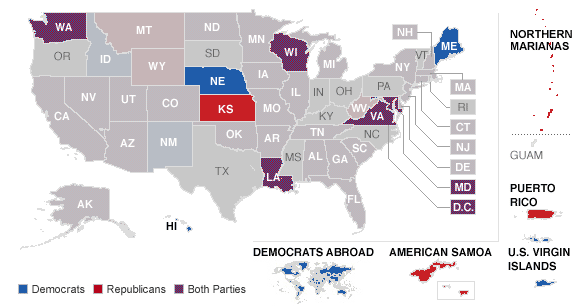
Obama wins 8 in a row! That's how most of the headlines are reading as this week draws to a close. “Tonight we're on our way!” Obama could be heard telling his supporters as the results came rolling in. As reported by the LA Daily news, Obama has pulled into the lead with 1,210 delegates, while Hillary pulls up the rear with 1,188. Both of them are still a ways away from the required 2,025 delegates required to win the primary.
It may not be so surprising that Obama is winning states over Clinton, but what is surprising is the margin in which he is doing so. In DC, Obama pulled in about 75% of the vote and in Virginia, he managed about 62%. As most people can agree, these are definite majorities.
Further adding to the agony of defeat that Clinton is currently experiencing, her deputy campaign manager, Mike Henry, resigned to leave the campaign in the hands of Maggie williams to build her own team. Clinton was quoted by the NY Daily News as saying, “I'm tested, I'm ready, let's make it happen.” Whether or not this new change in Clinton's campaign will lead to positive results in the remaining primaries we will have to wait and see.

http://www.nydailynews.com/news/politics/2008/02/12/2008-02-12_hillary_loses_deputy_campaign_manager.html?ref=rss

http://www.dailynews.com/ci_8244982